




What is Risk Management in Crypto?
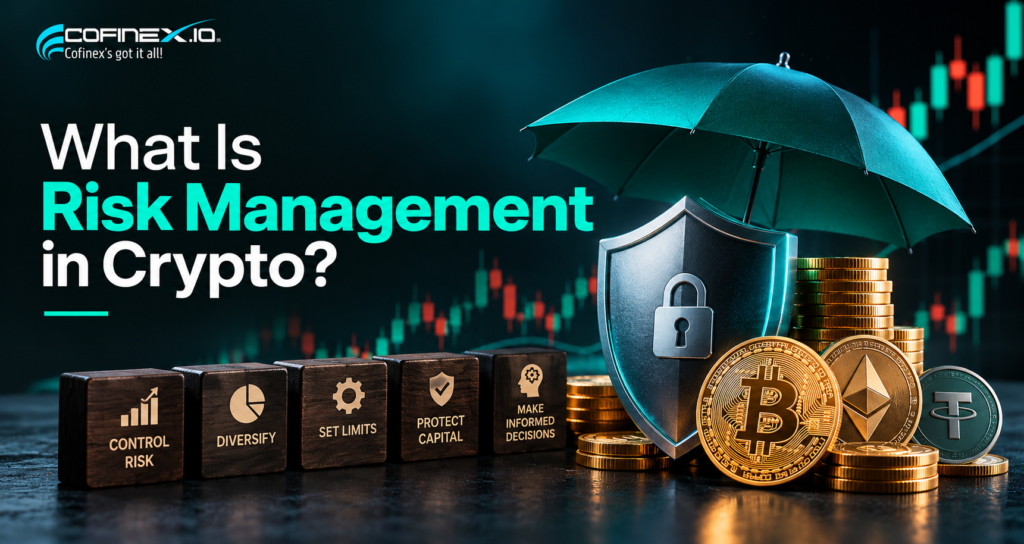
Introduction
Cryptocurrency can offer opportunities, but it also comes with significant risks. Prices can move quickly, markets can become volatile, and individual crypto assets can lose value.
Because of this, knowing how to manage risk is just as important as understanding how crypto works.
Crypto risk management is not about predicting every market move or avoiding losses completely. Instead, it is about making decisions that help you control how much you are willing to risk.
For beginners, a good risk management approach can help prevent one investment or trade from having an unnecessarily large impact on the overall portfolio.
What Is Risk Management in Crypto?
Crypto risk management means identifying, understanding, and managing the risks involved in cryptocurrency investing and trading.
These risks can come from different sources, including:
- Market volatility
- Large price movements
- Concentration in one asset
- Poor investment decisions
- Leverage
- Security problems
- Project-related risks
- Emotional trading
The goal is not to remove every risk. Instead, the goal is to understand those risks and decide how much exposure you are comfortable taking.
Why Is Risk Management Important?
Crypto markets can move sharply within short periods.
For example, imagine an investor puts their entire portfolio into one cryptocurrency. If that asset falls significantly, the investor’s entire portfolio is exposed to that decline.
However, someone who spreads their exposure across different assets may reduce their dependence on one investment.
This is one reason portfolio diversification can be part of a broader risk management strategy.
Still, diversification does not guarantee protection. Different crypto assets can fall together when the broader market declines.
Understand Your Risk Tolerance
Before investing or trading, it is important to understand your risk tolerance.
Risk tolerance refers to how much potential loss you are financially and emotionally prepared to accept.
For example, one person may be comfortable with large price fluctuations. Another person may find the same movements difficult to handle.
Your risk tolerance can depend on:
- Financial situation
- Investment goals
- Time horizon
- Existing investments
- Experience with volatile markets
Therefore, an investment strategy that works for one person may not be suitable for another.
Avoid Investing More Than You Can Afford to Lose
One of the basic principles of crypto risk management is to avoid putting money at risk that you cannot afford to lose.
Cryptocurrency prices can be unpredictable. Even projects that appear strong can face unexpected challenges.
For this reason, crypto investments should not come at the expense of essential expenses, emergency savings, or other important financial obligations.
A simple rule for beginners is:
Only take risks that fit your financial situation.
How Does Diversification Help?
Diversification means spreading investments across different assets rather than relying on one investment.
For example, instead of holding only one cryptocurrency, an investor may hold different assets based on their goals and risk tolerance.
Diversification can help reduce concentration risk.
However, owning many cryptocurrencies does not automatically create a well-diversified portfolio. Several crypto assets may respond similarly to major market events.
So, the goal should not simply be to own more assets. Instead, understand what you own and why you own it.
What Is Position Sizing?
Position sizing refers to deciding how much of your portfolio or available capital to put into a particular investment or trade.
For example, suppose someone has ₹1,00,000 available for investment.
Putting the entire amount into one highly volatile asset creates much greater exposure than allocating only a smaller portion to that asset.
Position sizing can therefore help control the impact of an individual investment.
There is no universal percentage that works for everyone. The appropriate amount depends on factors such as risk tolerance, investment goals, and the asset itself.
Understand Crypto Volatility
Volatility describes how much and how quickly an asset’s price changes.
Cryptocurrency markets can experience significant price movements. Therefore, investors should be prepared for the possibility of both rapid gains and sharp declines.
For beginners, it is important to avoid making decisions based only on short-term price movements.
Instead, consider:
- Why are you investing?
- How long do you plan to hold?
- How much loss can you tolerate?
- Has the risk of the investment changed?
This approach can help reduce emotional decisions.
What About Stop-Loss Orders?
A stop-loss order is a trading tool that can help traders limit potential losses by triggering an order when the market reaches a specified price.
For example, a trader may decide that they do not want to continue holding a position if the price falls to a certain level.
However, stop-loss orders are not a perfect safety mechanism.
In a fast-moving or low-liquidity market, the final execution price may differ from the expected level. Therefore, beginners should understand how their exchange handles stop orders before using them.
Stop-loss orders are mainly relevant to trading, rather than being a requirement for every long-term investment.
Be Careful With Leverage
Leverage allows traders to control a larger position using a smaller amount of capital.
While leverage can increase potential returns, it can also increase potential losses.
For example, a small price movement against a leveraged position can have a much larger effect on the trader’s available capital.
As a result, beginners should understand leverage thoroughly before using it.
If you do not understand how liquidation, margin, and leveraged positions work, avoiding leverage while learning may reduce unnecessary risk.
Security Is Also Part of Risk Management
Risk management is not only about price movements.
Crypto holders also need to consider security risks.
For example:
- Protect your private keys.
- Keep your recovery phrase private.
- Use strong passwords.
- Enable two-factor authentication where available.
- Be careful with suspicious links and messages.
- Verify wallet addresses before sending funds.
Even if an investment performs well, poor security practices can still result in a loss.
Common Risk Management Mistakes
Investing Based on Emotions
Fear and excitement can influence decisions. Buying because prices are rising rapidly or selling because of panic can lead to poor choices.
Putting Everything Into One Asset
This creates high concentration risk.
Using Too Much Leverage
Leverage can magnify losses as well as gains.
Ignoring Volatility
Crypto prices can move much faster than beginners expect.
Following Someone Else’s Strategy
Another person’s risk tolerance and financial situation may be completely different from yours.
Chasing Quick Profits
Trying to make fast returns can encourage unnecessary risk-taking.
Forgetting Security
Investment risk is not the only risk. Wallet and account security matter too.
A Simple Risk Management Example
Imagine you have ₹1,00,000 that you have decided to allocate toward investments.
Instead of putting the entire amount into one highly volatile cryptocurrency, you may choose to spread your exposure based on your financial goals and risk tolerance.
You could also decide in advance:
- How much you are comfortable allocating to crypto
- How much exposure you want to one asset
- Whether you will use leverage
- How long you plan to hold
- What conditions would make you reconsider the investment
The exact allocation is a personal decision. There is no single formula that works for every investor.
The important part is planning the risk before making the investment, rather than reacting after a large price movement occurs.
FAQs
Is crypto risk management only for traders?
No. Both investors and traders can benefit from risk management. However, the tools they use may differ.
Does diversification eliminate crypto risk?
No. Diversification can reduce concentration risk, but several crypto assets can still decline at the same time.
Is leverage a risk management strategy?
No. Leverage increases exposure and can magnify both gains and losses. It should be understood as a higher-risk trading tool.
Can a stop-loss guarantee that I will lose only a fixed amount?
No. In fast-moving or low-liquidity markets, execution can occur at a different price from the stop level.
What is the most important part of risk management?
There is no single rule for everyone. Understanding your financial situation, risk tolerance, investment goals, and exposure is a good starting point.
Disclaimer
This article is for educational purposes only and does not provide financial or investment advice. Cryptocurrency investments and trading involve significant risks, including the possible loss of capital. Always conduct your own research and consider your financial circumstances before making investment decisions.