




How do smart contract upgrades work and why do they matter?
Smart contracts are an important part of blockchain technology. They power decentralised applications, token transfers, lending platforms, NFT marketplaces, and many other blockchain-based services.
However, what happens when a smart contract contains a bug, needs a security improvement, or requires a new feature?
Unlike traditional software, smart contracts often run on blockchains where deployed code cannot simply be edited like a regular application. Therefore, developers need specific methods to update or replace smart contracts.
This process is known as a smart contract upgrade.
In this lesson, we will explore how smart contract upgrades work, why projects need them, and what risks users should understand before interacting with upgradeable contracts.
1. What is a smart contract?
A smart contract is a programme deployed on a blockchain that executes instructions when predefined conditions are met.
For example, imagine a decentralised lending application. A smart contract can manage deposits, calculate interest according to its programmed rules, and process eligible withdrawals.
Once deployed, the contract operates according to its code and the rules of the blockchain.
However, developers may discover problems or identify opportunities to improve the contract after deployment. In such cases, an upgrade may become necessary.
2. What is a smart contract upgrade?
A smart contract upgrade is a process used to change or improve the functionality of an existing blockchain application.
An upgrade may introduce new features, fix vulnerabilities, improve performance, or modify existing rules.
For example, suppose a decentralised application has a smart contract that supports token deposits and withdrawals. Later, developers identify a security weakness in its withdrawal process.
They may introduce an updated contract that addresses the issue.
However, the method used to upgrade a contract depends on how developers designed it before deployment.
Importantly, not every smart contract can be upgraded directly. Some contracts are designed to remain unchanged after deployment.
3. Why do smart contracts need upgrades?
Although developers test smart contracts before deployment, no software is completely free from errors or vulnerabilities.
Here are some common reasons why projects upgrade their contracts.
Security improvements
Security is one of the main reasons for contract upgrades.
Developers may discover vulnerabilities that could allow unauthorised access, incorrect transactions, or loss of funds. Therefore, they may need to introduce changes to reduce these risks.
However, an upgrade cannot guarantee complete security. The updated code must also undergo careful testing and review.
Bug fixes
Sometimes, a contract may contain programming errors that affect how it performs certain operations.
For example, a calculation error could cause a reward distribution mechanism to work incorrectly.
Developers may release an updated implementation to correct the issue.
Adding new features
Blockchain applications evolve over time. As a result, developers may introduce new features to improve the user experience or support additional services.
For instance, a decentralised finance application may update its contract to support another token or introduce a new lending feature.
Improving efficiency
Developers may also upgrade contracts to improve how they use blockchain resources.
For example, changes may reduce unnecessary operations or make certain processes more efficient. However, any proposed change must still follow the rules of the blockchain.
Adapting to changing requirements
A project may need to change its contract logic as its ecosystem grows.
For example, developers may update governance rules, introduce new reward mechanisms, or modify certain parameters to support the application’s development.
4. How do smart contract upgrades work?
There are different ways to upgrade smart contracts. The approach depends on the contract’s original design.
Let’s understand three common methods.
Method 1: Deploying a new contract
One straightforward method is to deploy a completely new smart contract.
Developers create an updated version, test it, and deploy it to the blockchain.
After deployment, the project may ask users to interact with the new contract instead of the old one.
For example, a token project may deploy a new contract to introduce improved functionality. Depending on the design, users may need to transfer or migrate their tokens to the new contract.
However, this method can create additional work for users and developers. The old contract may also remain on the blockchain, even after the project stops using it.
Method 2: Proxy contracts
A proxy contract is a common method for creating upgradeable smart contracts.
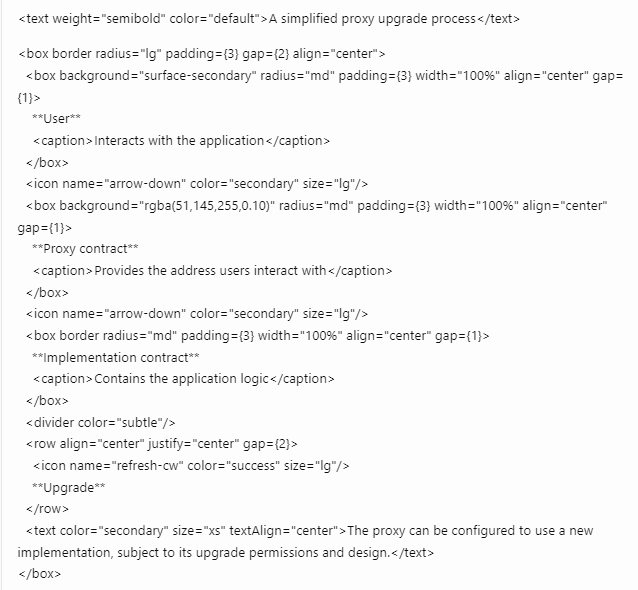
In this arrangement, users interact with a proxy contract, which delegates execution to another contract called the implementation contract.
The proxy generally maintains the relevant storage, while the implementation contract contains the logic used to execute operations.
When developers upgrade the application, they can change which implementation the proxy points to.
This allows the application to use updated logic while retaining the proxy address and, when correctly designed, its existing state.
Although proxy contracts make upgrades easier, they introduce additional considerations. For example, incorrect storage layouts or poorly controlled upgrade permissions can create serious security problems.
Method 3: Diamond pattern
The Diamond pattern is another approach to building upgradeable smart contracts.
Instead of relying on one large implementation contract, it divides functionality into smaller modules called facets.
Each facet handles specific functions. A central diamond contract routes user requests to the relevant facet.
Developers can add, replace, or remove certain facets without replacing the entire application structure.
This approach can be useful for complex applications. However, it also introduces additional design and security considerations.
5. Who controls smart contract upgrades?
One important question is: who has permission to change a smart contract?
The answer depends on the project’s governance and contract design.
Some projects allow a development team or administrator to approve upgrades. Others use multisignature wallets, decentralised governance, or time-lock mechanisms.
Here are some common arrangements:
- Admin-controlled upgrades: A designated administrator can approve or execute contract changes.
- Multisignature approval: Multiple authorised signers must approve an upgrade before it can proceed.
- DAO governance: Token holders or designated governance participants vote on proposed changes, according to the project’s rules.
- Timelock mechanism: An approved upgrade must wait for a specified period before execution.
These arrangements can improve accountability, but they do not automatically make a contract safe.
For example, if one administrator has unrestricted upgrade permissions, that person or compromised account may be able to change the contract’s behaviour.
Therefore, always check who controls the upgrade mechanism.
6. What are the risks of smart contract upgrades?
Upgradeable contracts offer flexibility, but they also introduce risks that users should understand.
Centralisation risk
If only one person or organisation controls upgrades, users must trust that authority to act responsibly.
A compromised administrator account could potentially approve harmful changes.
Malicious upgrades
An authorised upgrade mechanism could be misused to introduce harmful code.
Depending on the contract’s permissions and design, this could affect user balances, withdrawals, or other application functions.
Storage compatibility problems
Upgradeable contracts must handle stored data carefully.
For example, a poorly designed implementation update may change how the contract reads or writes existing data. This can lead to unexpected behaviour or application failures.
New vulnerabilities
An upgrade intended to improve security may introduce new bugs.
Therefore, developers should test updated code and arrange appropriate security reviews before implementation.
Governance risks
If upgrades depend on community voting, low participation or concentrated voting power may affect decisions.
As a result, governance processes should be transparent and clearly documented.
User confusion
Some upgrades require users to migrate tokens, approve new contracts, or take other actions.
Without clear communication, users may interact with outdated contracts or fall victim to fake upgrade announcements.
Always verify upgrade instructions through official project channels.
7. How can users check whether a smart contract is upgradeable?
You do not need to be a blockchain developer to perform basic checks.
However, you should know where to look.
Here are some useful steps:
- Check the contract address: Find the official address through the project’s verified website or documentation.
- Use a blockchain explorer: Open the contract on an explorer such as Etherscan.
- Review the contract information: Look for verified source code and proxy indicators, where available.
- Check upgrade permissions: Examine whether an administrator, multisignature wallet, or governance mechanism controls upgrades.
- Review upgrade history: Check whether the implementation address or contract logic has changed.
- Read official announcements: Verify whether the project has explained the reason and impact of an upgrade.
A blockchain explorer can help you inspect contract activity and verified code. However, interpreting proxy permissions and implementation details may require technical knowledge.
8. Upgradeable vs immutable smart contracts
Not every project chooses to make its smart contracts upgradeable.
Some contracts are designed to remain immutable, meaning their deployed code cannot be changed through an administrative upgrade mechanism.
| Upgradeable contracts | Immutable contracts |
|---|---|
| Can support changes through an upgrade mechanism | Deployed code cannot be directly changed |
| Allow developers to fix bugs or add features through upgrades | Changes generally require deploying a new contract |
| May depend on administrators or governance | Avoid certain upgrade-control risks |
| Require users to consider upgrade permissions | Still carry risks from original code and design |
Neither approach is automatically better in every situation.
Upgradeable contracts offer flexibility, while immutable contracts provide stronger guarantees that their deployed logic will not be changed through an upgrade mechanism.
However, immutability does not guarantee that a contract is secure or free from bugs.
Final thoughts
Smart contract upgrades help blockchain applications adapt, improve security, fix bugs, and introduce new features.
At the same time, they create important questions about permissions, governance, storage compatibility, and user protection.
Before interacting with an upgradeable contract, understand who controls it, how upgrades are approved, and whether the project communicates changes transparently.
Most importantly, remember that an upgradeable contract is not automatically unsafe, and an immutable contract is not automatically secure. The quality of the code, security practices, and governance structure all matter.
Frequently asked questions
1. Can smart contracts be changed after deployment?
Some smart contracts can be upgraded through mechanisms such as proxy contracts. However, contracts without an upgrade mechanism generally cannot have their deployed code directly modified.
2. What is a proxy contract in blockchain?
A proxy contract is a contract that allows users to interact with an application while delegating execution to a separate implementation contract. Developers can update the implementation without necessarily changing the proxy address.
3. Are upgradeable smart contracts safe?
Upgradeable contracts can be useful, but their safety depends on code quality, testing, upgrade permissions, governance, and security practices. Poorly controlled upgrade mechanisms can create additional risks.
4. What is an immutable smart contract?
An immutable smart contract is designed so that its deployed code cannot be directly changed through an upgrade mechanism. If developers need different functionality, they generally deploy another contract.
5. Who can approve a smart contract upgrade?
Depending on the design, upgrades may be controlled by an administrator, a multisignature wallet, a DAO governance process, or another authorised mechanism.
6. Does a smart contract audit guarantee that an upgrade is safe?
No. An audit reviews code within a defined scope, but it cannot guarantee complete security. Updated implementations should also undergo appropriate testing and security reviews.
Disclaimer
This article is intended for educational and informational purposes only. It does not constitute financial, investment, legal, or technical advice. Smart contract upgrades involve potential security, governance, and operational risks. Always verify contract addresses, review official documentation, and conduct independent research before interacting with blockchain applications.