




What is the Bitcoin mempool and why do transaction fees change?
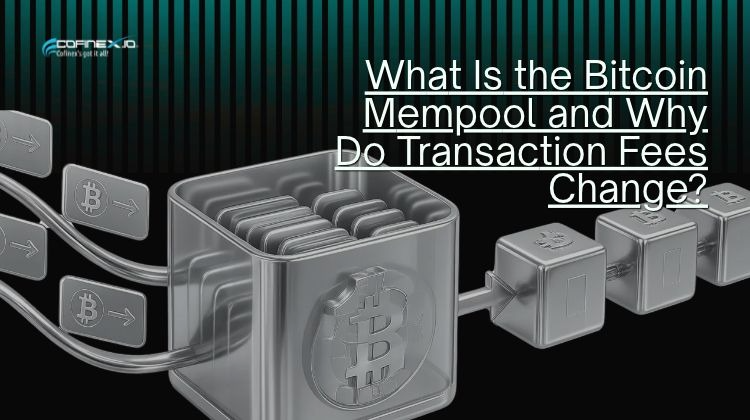
Have you ever sent Bitcoin and noticed that your transaction took longer than expected to confirm? Or perhaps you paid a higher transaction fee during a busy period.
These situations often happen because of the Bitcoin mempool.
The mempool plays an important role in how Bitcoin transactions move from one wallet to the blockchain. It also helps explain why transaction fees can increase or decrease depending on network activity.
But what exactly is the Bitcoin mempool? How does it work, and why do some transactions confirm faster than others?
Let’s understand it step by step.
What is the Bitcoin mempool?
The Bitcoin mempool, short for memory pool, is a temporary holding area for unconfirmed Bitcoin transactions.
When someone sends Bitcoin, the transaction does not immediately become part of the blockchain. Instead, it first reaches Bitcoin nodes, which check whether it follows the network’s rules.
If a node accepts the transaction, it may keep it in its mempool while waiting for a miner to include it in a block.
In simple terms, think of the mempool as a waiting queue for Bitcoin transactions.
However, there is an important detail: Bitcoin does not have one central mempool. Each node maintains its own collection of unconfirmed transactions. Therefore, different nodes may have slightly different mempools.
How does the Bitcoin mempool work?
The mempool helps organise transactions before miners add them to the blockchain.
Here is how the process works:
1. A user sends Bitcoin
First, a user creates a Bitcoin transaction through a wallet. The transaction includes details such as the sender’s inputs, the recipient’s address and the amount being transferred.
The wallet also calculates a transaction fee.
2. The transaction reaches Bitcoin nodes
Next, the wallet broadcasts the transaction to the Bitcoin network.
Nodes check whether the transaction follows the network’s rules. For example, they verify the transaction’s signatures and check that it does not attempt to spend the same Bitcoin twice.
If a node accepts the transaction, it may add it to its mempool and share it with other nodes.
3. The transaction waits in the mempool
After entering the mempool, the transaction waits for a miner to select it.
However, transactions do not all receive equal priority. Miners generally consider the fee rate a transaction offers when selecting transactions for a block.
As a result, transactions with more competitive fee rates may receive attention sooner.
4. A miner includes the transaction in a block
Once a miner selects the transaction and successfully mines a valid block, the transaction becomes part of the blockchain.
At this point, it receives its first confirmation.
5. More blocks add confirmations
As miners add more blocks after the transaction’s block, the transaction receives additional confirmations.
Generally, more confirmations provide stronger assurance that the transaction will remain part of the blockchain.
Why do Bitcoin transaction fees change?
Bitcoin transaction fees do not follow a fixed price.
Instead, users compete for limited space in each block. When many people want to send Bitcoin at the same time, they may offer higher fees to encourage miners to select their transactions.
Consequently, fees can rise during periods of heavy network activity.
Let’s look at the main factors that influence them.
1. Network congestion
Network congestion occurs when many transactions compete for space in the mempool.
For example, imagine that a large number of users send Bitcoin during the same period. If miners cannot confirm all those transactions immediately, the mempool may grow.
As a result, users may offer higher fee rates to improve their chances of getting included in an upcoming block.
On the other hand, when fewer transactions compete for space, users may be able to pay lower fees.
2. Transaction size
Bitcoin fees depend largely on transaction size, measured in virtual bytes (vB), rather than simply the amount of Bitcoin being transferred.
For example, sending 0.01 BTC does not automatically cost less than sending 1 BTC.
A transaction with more inputs or a more complex structure may require more block space. Therefore, it can cost more even when the transferred amount is smaller.
3. Fee rate
Bitcoin users generally express transaction fees as satoshis per virtual byte, written as sat/vB.
A satoshi is the smallest unit of Bitcoin.
One Bitcoin equals 100 million satoshis.
For example, consider two transactions with the same virtual size:
- Transaction A offers 5 sat/vB.
- Transaction B offers 20 sat/vB.
Transaction B offers a higher fee rate. Therefore, miners may prefer it when choosing transactions for a block.
However, a higher fee rate does not guarantee immediate confirmation.
4. Miner selection
Miners choose transactions from their own mempools when building blocks.
Since each block has limited capacity, miners generally prioritise transactions that offer higher fees relative to the block space they use.
Therefore, users who offer competitive fee rates may improve their chances of faster confirmation.
However, miners can also consider other factors, and different miners may select different transactions.
5. Sudden increases in network activity
Certain events can increase Bitcoin network activity.
For instance, a rise in market activity, popular blockchain applications or a large number of transactions can increase competition for block space.
Consequently, the mempool may grow and fee rates may change quickly.
What happens when the Bitcoin mempool becomes full?
The Bitcoin mempool does not have one universal capacity limit across the entire network. Each node manages its own mempool according to its settings and available resources.
However, when a node reaches its configured mempool limit, it may remove lower-fee transactions to make room for new ones.
This can affect transactions that offer less competitive fee rates.
For example, a transaction may remain unconfirmed for a longer period. In some situations, it may disappear from a particular node’s mempool without ever entering a block.
Importantly, this does not automatically mean that the Bitcoin has disappeared. The sender may need to wait, rebroadcast the transaction or use an appropriate replacement method, depending on the transaction and wallet.
How can you check the Bitcoin mempool?
You do not need advanced technical knowledge to understand current Bitcoin network activity.
Several blockchain explorers and mempool tools provide information about unconfirmed transactions and estimated fee rates.
For example:
- Mempool.space: Displays the Bitcoin mempool, fee estimates and block activity.
- Blockchain.com Explorer: Allows users to explore Bitcoin transactions and blocks.
- Blockstream Explorer: Provides information about Bitcoin transactions, addresses and blocks.
These tools can help you understand whether the network has many pending transactions and what fee rates users are currently offering.
However, fee estimates are not guarantees. Actual confirmation times depend on network conditions and miner selection.
How can you avoid paying unnecessarily high Bitcoin fees?
You cannot control overall network demand, but you can make informed decisions when sending Bitcoin.
Here are some useful practices:
- Check network activity: Before sending Bitcoin, review current mempool conditions and fee estimates.
- Choose an appropriate fee rate: If your transaction is not urgent, you may consider a lower fee rate when network activity allows it.
- Avoid unnecessary transactions: Combining payments where practical can help reduce the number of separate transactions.
- Use wallet fee recommendations carefully: Wallets often provide fee estimates, but you should understand the options before selecting one.
- Understand transaction urgency: A time-sensitive payment may require a more competitive fee than a transaction that can wait.
Most importantly, do not assume that paying the highest suggested fee is always necessary.
Frequently asked questions (FAQs)
1. What happens when a Bitcoin transaction enters the mempool?
When a transaction enters a node’s mempool, it waits for a miner to select it and include it in a block. Once the network confirms that block, the transaction becomes part of the blockchain.
2. Does the Bitcoin mempool have a fixed size?
No. Different nodes can configure their mempool limits differently. Therefore, there is no single universal mempool size for the entire Bitcoin network.
3. Why are Bitcoin transaction fees sometimes high?
Fees can rise when many transactions compete for limited block space. During busy periods, users may offer higher fee rates to improve their chances of faster confirmation.
4. Can a Bitcoin transaction remain unconfirmed?
Yes. A transaction may remain unconfirmed when miners have not selected it for a block. Its waiting time can depend on its fee rate and current network activity.
5. Does sending a larger amount of Bitcoin mean paying a higher fee?
Not necessarily. Bitcoin transaction fees depend mainly on the transaction’s virtual size and fee rate, rather than the amount of Bitcoin transferred.
6. Can I track my Bitcoin transaction?
Yes. You can use a Bitcoin blockchain explorer to search for your transaction ID (TXID) and check its status, fee and confirmation details.
Disclaimer: This article is for educational purposes only and does not provide financial or investment advice. Bitcoin transaction fees and confirmation times can change depending on network conditions. Always review transaction details before confirming a payment.